
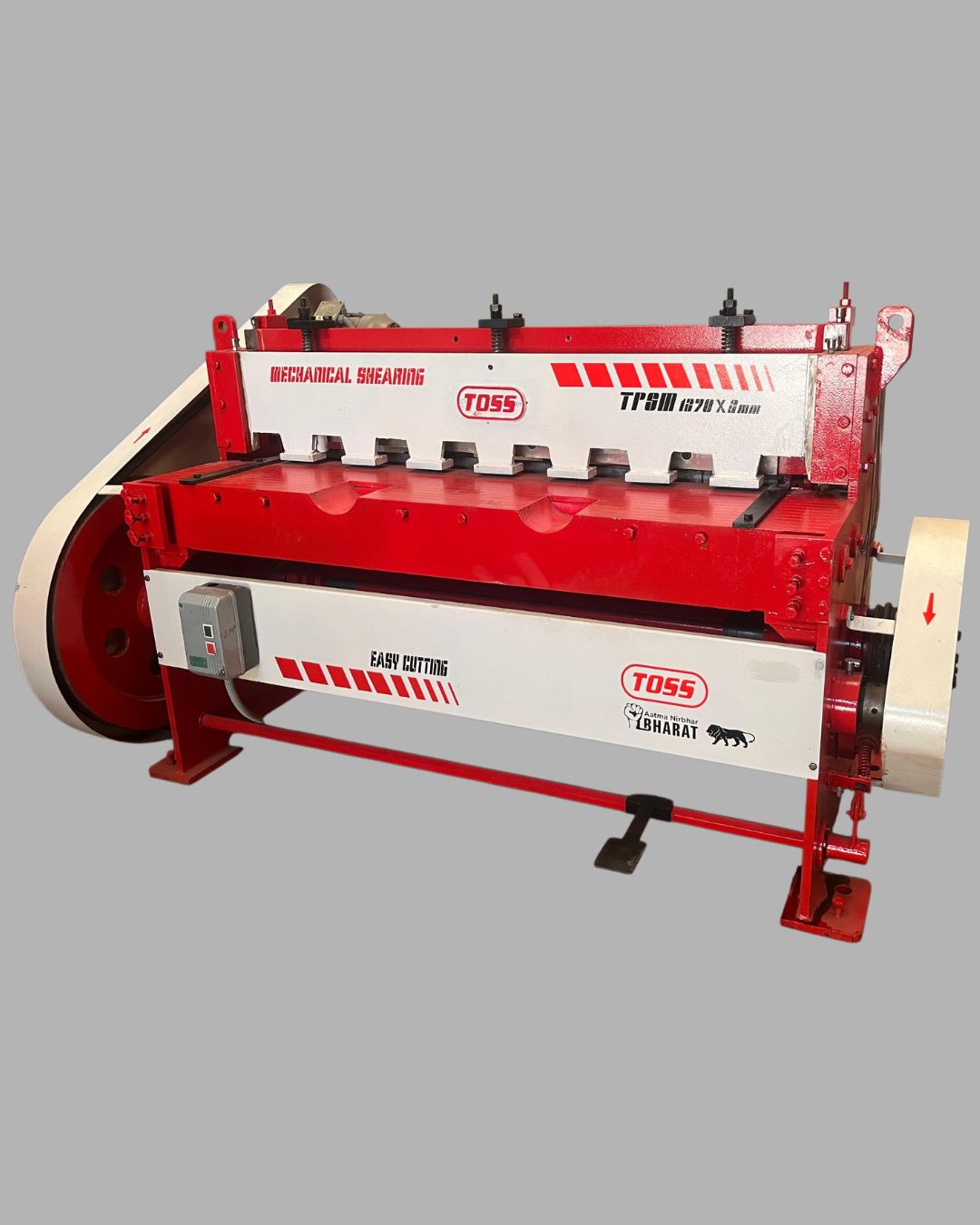
Mechanical Under Crank Shearing Machine
A Mechanical Shearing Machine is a heavy-duty industrial tool used to cut sheet metal and metal plates with high precision. It operates using a reciprocating motion where a moving upper blade descends against a fixed lower blade to shear the material, much like an oversized pair of scissors designed for industrial use.
Core Components
- The Bed: The flat and rigid surface that supports the metal sheet during cutting.
- The Ram: The moving upper section of the machine that carries the cutting blade.
- The Blades:
- Upper Blade: Slightly angled (rake angle) to reduce the cutting force.
- Lower Blade: Fixed blade mounted to the bed for stable shearing.
- Hold-down Clamps: Hydraulic or mechanical clamps that hold the sheet firmly in place during cutting.
- Back Gauge System: Adjustable stop that helps position the sheet for precise cutting dimensions.
Working Mechanism
Unlike hydraulic shearing machines that rely on fluid pressure, mechanical shears use a flywheel-driven mechanism to generate cutting force.
- Energy Storage: An electric motor rotates a heavy flywheel that stores kinetic energy.
- Clutch Engagement: When the operator presses the foot pedal, the clutch engages and connects the flywheel to the crankshaft.
- Cutting Stroke: The crankshaft converts rotary motion into a linear downward motion that drives the ram and upper blade through the metal.
- Return Stroke: After the cut is completed, the ram returns to its starting position and the clutch disengages.
Technical Specifications (Typical)
| Specification | Description |
|---|---|
| Shearing Capacity | Up to 6mm – 12mm thickness depending on machine model |
| Cutting Length | 1250mm to 3200mm |
| Strokes Per Minute | 20 – 60 SPM |
| Rake Angle | 1° to 3° depending on design |
| Operation Type | Mechanical Flywheel System |
| Power Source | Electric Motor with Flywheel Drive |
Advantages
- High Production Speed: Mechanical shears operate faster than hydraulic machines.
- Simple Mechanism: Fewer hydraulic components reduce maintenance complexity.
- Efficient for Mass Production: Ideal for high-volume sheet cutting operations.
Limitations
- No Overload Protection: Cutting material beyond capacity can damage components.
- Higher Noise Levels: Mechanical impact and clutch operation produce more noise.
Common Applications
- Sheet metal fabrication workshops
- Automotive body panel manufacturing
- Metal furniture production
- Industrial fabrication and construction
- Steel processing industries
Safety Tip
Operators should ensure that the metal sheet is properly aligned against the back gauge and firmly held by the hold-down clamps. Protective gloves, eye protection, and proper machine guarding are essential for safe operation.


Reviews
There are no reviews yet.